






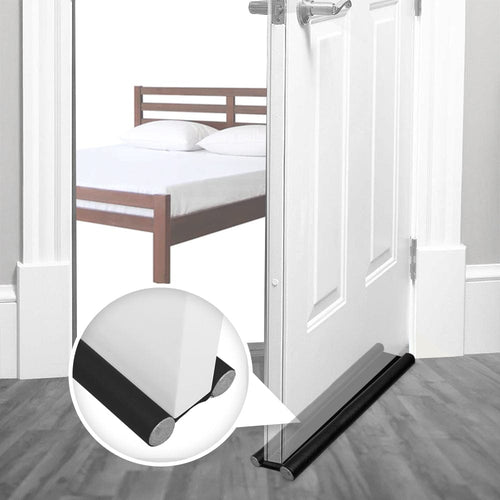


Arrowzoom Mini Bass Trap — Kill Low-End Boom in Studios & Home Theaters — KK1133
Arrowzoom Mini Bass Trap — Kill Low-End Boom in Studios & Home Theaters — KK1133
✅ Eliminates low-end boom in minutes
✅ NRC 0.74, STC 27 proven performance
✅ Fire-safe, non-toxic high‑density foam
✅ East unstall with zero mess


Couldn't load pickup availability
-
Ordered
-
Shipped
- - -
At Your Doorstep

Bass boom isn't a speaker problem. It's a room problem.
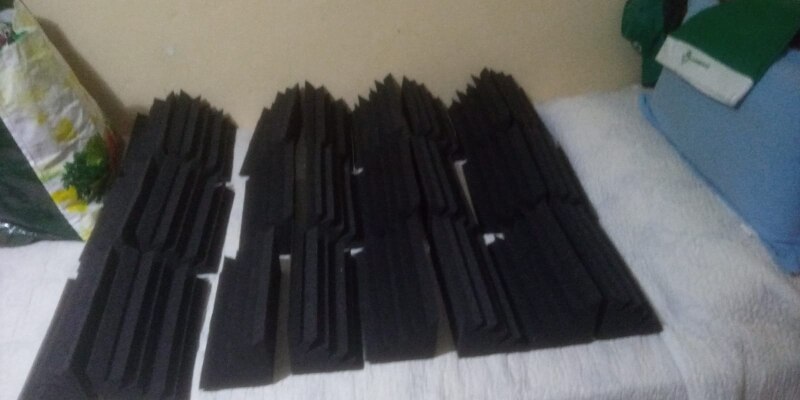
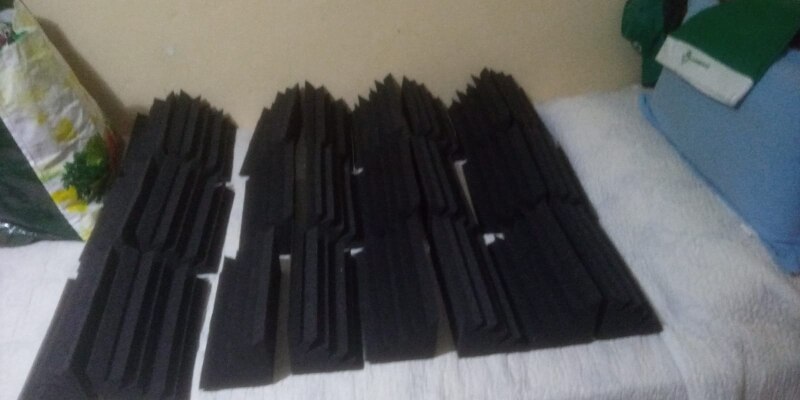
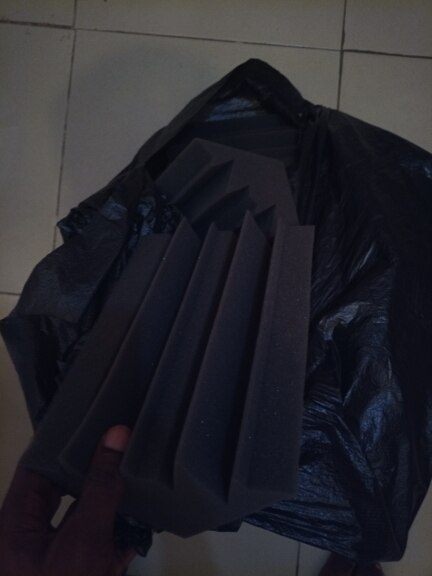
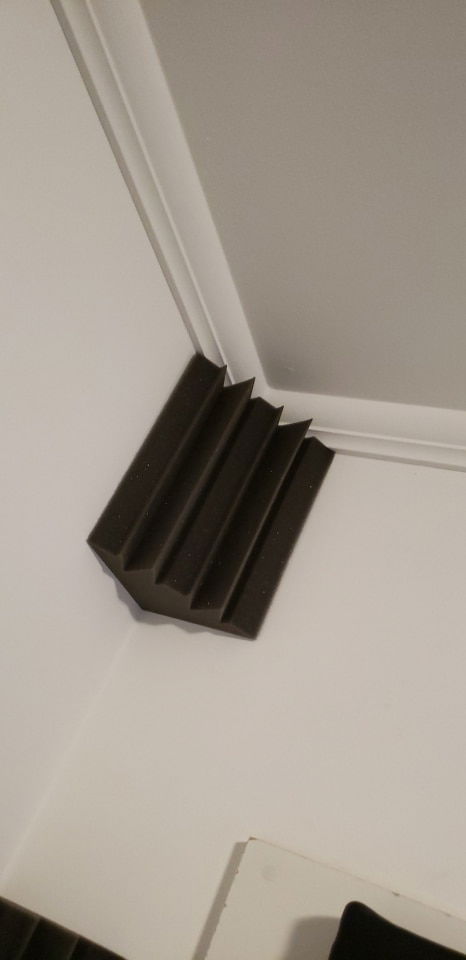
The Arrowzoom Mini Bass Trap absorbs the low-frequency energy that pools in your corners and ruins your mixes, your movies, and your monitor calls. Lab-rated NRC 0.74, STC 27. Corner-fit footprint — 4.7 × 4.7 × 9.4 in (12 × 12 × 24 cm). Stack them in fours where the bass builds, and the room finally gets out of the way.
Why your room booms (and what fixes it)
Low frequencies don't reflect like high frequencies. They build up. In every rectangular room, bass energy collects in the corners — that's where two walls and a floor or ceiling meet. The result: a 60–250 Hz hump that makes kick drums sound flabby, dialogue sound muddy, and mixes that fall apart on every other speaker you play them on.
The fix isn't a thicker foam square on the wall. It's mass in the corners. The Mini Bass Trap is high-density acoustic foam shaped to wedge into the corner where the energy collects. Stack four to six per corner and the room mode flattens — without padding the entire room.
What NRC and STC actually mean
NRC (Noise Reduction Coefficient) — how much sound a surface absorbs on a 0 to 1 scale. NRC 0.74 means 74% of the sound that hits the trap is absorbed; only 26% bounces back into the room. For reference: a bare drywall is around 0.05. Standard 2-inch foam squares average 0.30. Premium broadband absorbers run 0.85–1.00.
STC (Sound Transmission Class) — how much sound a material blocks from passing through. STC 27 is the trap's measured transmission-loss rating in the speech band. For reference: a hollow-core door is STC 20. A solid-core door is STC 30. A standard interior wall is STC 33.
Bottom line: the Mini Bass Trap is built to absorb low-end energy in the room you're already in. Combine it with proper wall mass for full isolation.
Technical data — full frequency response
| Material | High-density open-cell acoustic foam, fire-retardant, non-toxic |
|---|---|
| Dimensions (each) | 4.7 × 4.7 × 9.4 in (12 × 12 × 24 cm) |
| Weight (each) | ~2.8 oz (~80 g) |
| NRC (overall) | 0.74 |
| STC (overall) | 27 |
| Color | Black · Burgundy |
| Fire rating | Self-extinguishing — meets US studio safety standards |
| Toxicity | Non-toxic, low VOC — safe for living rooms and bedrooms |
| Shipping | Vacuum-sealed — restores full size in 24–48 hours after unpacking |
Octave-band performance (third-party impedance-tube test)
| Center frequency | Transmission Loss (dB) · Absorption Coefficient |
|---|---|
| 125 Hz | 17 dB · 0.11 |
| 250 Hz | 17 dB · 0.34 |
| 500 Hz | 22 dB · 0.84 |
| 1000 Hz | 27 dB · 1.06 |
| 2000 Hz | 30 dB · 1.03 |
| 4000 Hz | 58 dB · 1.00 |
| Overall STC | 27 |
Why Arrowzoom Mini Bass Trap beats the alternatives
| What matters | Arrowzoom KK1133 | Typical competitor corner trap |
|---|---|---|
| Footprint per unit | 4.7 × 4.7 × 9.4 in (12 × 12 × 24 cm) | 24 × 12 × 12 in (61 × 30 × 30 cm) |
| Weight per unit | ~2.8 oz (~80 g) | 1.5–2 lb (680–907 g) |
| Measured NRC | 0.74 | Often unpublished |
| Measured STC | 27 | Often unpublished |
| Color options | Black · Burgundy (studio finish) | Charcoal only |
| Pack sizes | 2 / 4 / 8 / 12 / 24 | 4-pack only |
| Guarantee | 100-day, no restocking | 30-day, 15–25% restocking |
| Best for | Small studios, home theaters, apartments, gaming rooms | Large pro studios with full corner real estate |
Choose your pack size
- 2-Pack — try a single corner. Best for monitor speakers and a desk setup.
- 4-Pack — one full corner stack, floor-to-near-ceiling. The most-asked-for entry pack.
- 8-Pack — two corners. Standard for a small mixing room or home theater front wall.
- 12-Pack — three corners. Most popular for serious bedroom studios.
- 24-Pack — all four corners plus ceiling-wall junctions. Full-room low-end treatment.
What's in the box
- 2 / 4 / 8 / 12 / 24 Mini Bass Trap units, vacuum-sealed
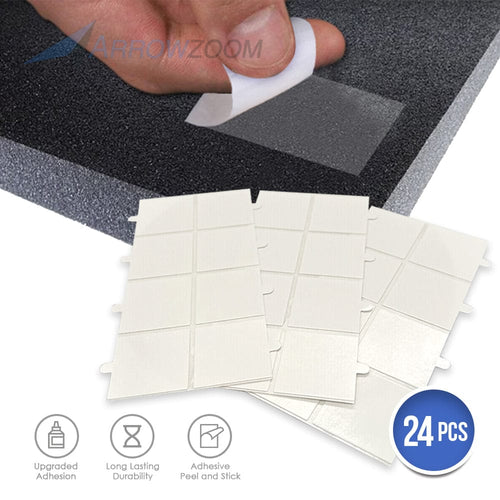
- 4 Arrowzoom sticky double-sided tape tabs per unit
- Step-by-step install guide
- Color: Black or Burgundy (matches studio and living-room finishes)
Install in 4 steps
- Unpack and restOpen the vacuum-sealed bag and let the foam restore its full size — 24 to 48 hours at room temperature. Don't rush this; the foam needs to breathe back into shape for the rated NRC.
- Find your bass cornersWalk the room with low-frequency music playing. The corners where bass is loudest are where you install. Standard rule: prioritize the front-wall corners (behind your speakers or screen) first.
- Clean and stickWipe the corner surfaces with rubbing alcohol so the adhesive bonds. Peel a sticky tab, press it to the back of each Mini Bass Trap, then press into the corner. 4 tabs per unit.
- Stack verticallyFor each corner, stack 4 units (about 38 in / 96 cm tall) for entry-level treatment, or 6 units (~56 in / 142 cm) for serious low-end control. Floor-up is fine; floor-down is fine.
Made for
- Bedroom and project studios fighting room-mode boom on every mix
- Home theaters where the subwoofer overpowers dialogue
- Podcast booths and voiceover rooms with muddy low-mid response
- Gaming rooms with corner-loaded subs that rattle the walls
- Apartments and condos where neighbors complain about the bass
- Anyone who's bought 2-inch foam squares and still hears the boom
Hear the difference, or your money back.
Install them. Mix on them. Live with them for up to 100 days. If the boom is still there, send them back for a full refund. No restocking fees. Trusted by 10,000+ Arrowzoom customers.
Frequently asked questions
Will this actually kill bass boom in my room?
Yes, when stacked in the corners where bass collects. Lab-measured NRC 0.74 means 74% of the sound energy that hits each trap is absorbed instead of bouncing back. For a typical bedroom studio, 4–8 units per corner is enough to flatten a 60–120 Hz room-mode hump that ruins kick-drum and bass mixes.
How many do I need for my room?
Quick rule: start with 4 units per front-wall corner (8 total). For a fully treated small studio or home theater, add the back-wall corners — 16 total. For maximum low-end control, add the ceiling-wall junctions along the front wall — 24 total. The 12-pack is our most-shipped size.
What's the difference between NRC and STC?
NRC (Noise Reduction Coefficient) measures absorption — how much sound the trap soaks up inside the room. KK1133 is NRC 0.74. STC (Sound Transmission Class) measures blocking — how much sound is stopped from passing through a wall or door. KK1133 is STC 27. Use bass traps to treat the room you're in. Use wall mass (drywall, MLV, doors) to block sound from leaving the room.
Will it stop my neighbors from hearing my bass?
Not by itself. Bass traps absorb sound inside your room, which reduces the level reaching the wall, which reduces what bleeds through. For real isolation, you also need wall mass — drywall layering, MLV, soundproof doors. Treat first, isolate second.
How long until it returns to full size after I unpack?
24 to 48 hours at room temperature. Vacuum-sealed shipping cuts our freight cost so we can keep the price low, but the foam needs time to breathe back into its full shape. Don't install until it's fully restored — rated NRC depends on full thickness.
Is it really fire-safe and non-toxic?
Yes. The foam is fire-retardant — it self-extinguishes and does not spread flame. It's non-toxic and low-VOC, safe for living rooms, nurseries, and recording booths. Meets US studio safety standards.
Will the adhesive damage my walls?
Two install options. The included sticky tabs are removable on most painted drywall (they peel cleanly with a hairdryer to soften the adhesive). For a permanent install — or rougher surfaces — use a 1/2 in (~13 mm) bead of PL Polyurethane construction adhesive around the perimeter plus an X across the back. That's the strongest hold and the cleanest finish.
Black or Burgundy — which should I pick?
Black is the default for studios, control rooms, and home theaters. Burgundy reads warmer and works better in living-room and bedroom installs where the panels are visible. Both are studio-finish — no industrial lime-green or institutional gray.
How does it compare to Auralex LENRD or GIK Monster bass traps?
Smaller footprint (4.7 × 4.7 × 9.4 in vs 24 × 12 × 12 in), lower per-unit cost, comparable absorption per cubic inch of foam. The trade-off: large-format competitor traps absorb deeper into the sub-bass with a single unit. KK1133 is designed to stack — 4–6 units per corner — to get there at a lower price and a more flexible install.
Can I use it for vocal booths or as wall foam too?
Yes. While KK1133 is shaped for corner bass-trapping, the high-density foam works as broadband absorption on flat walls too. For vocal-booth use, line the back wall behind the mic with stacked Mini Bass Traps to kill room reflections.
What's the warranty and return policy?
100-day money-back guarantee. No restocking fees. If the room doesn't sound better, send it back. Free worldwide shipping on orders over $99.
How long does shipping take?
Handling: 1–2 business days from the warehouse. Standard shipping: 7–14 days to the US and most countries (free over $99). Express shipping: 7 days or less. Tracking emailed at dispatch.
Shipping & Returns
Shipping & Returns
Purchase over $99USD or more to get FREE Shipping.
Normal Shipping
- 1-2 weeks in your hands
Express Shipping
- 1 week or less in your hands
Returns Policy
- We accept returns under specific conditions. Please follow these guidelines:
- How to Initiate a Return: Email service@arrowzoom.com with your name and order number.
- No Refunds for Buyer’s Remorse: Ensure your order details (design, size, address) are correct before purchasing.
- Cancellation Fee: Orders canceled (shipped or not) incur a 15% fee due to production costs.
Returned Parcels:
- Reshipping requires you to pay the shipping fee.
- For wrong items or quality issues, we refund the product value minus a 50% restocking fee.
- Shipping costs are non-refundable.
Return Conditions:
- Items must be in new, unaltered condition.
- Returns for mistaken shipments must be approved within 3 working days of receipt.
- Requests must be made within 2 weeks of shipping.
Note: No credit is given for items damaged during shipping. Contact the shipping company for compensation.


Soundproofing FAQs
Frequently Asked Questions
How do I soundproof my wall against noisy neighbours? 🤫
How do I soundproof my wall against noisy neighbours? 🤫
Soundproofing aims to prevent sound from entering or leaving a room, like blocking noise from those pesky neighbours. For more tips, check out our guide on soundproofing against noisy neighbours! 📖
How many Acoustic Panels Do I Need?
How many Acoustic Panels Do I Need?
The first step is going to be installing acoustic panels on your walls. These reduce the reverberations and echoes in the space.
Use our Free Tiles Calculator to find out
How do you install soundproofing? 🔧
How do you install soundproofing? 🔧
There are two main options for installing our DIY soundproofing solutions, and we're here to support you every step of the way!
DIY Installation:
All of our systems are DIY-friendly, saving you on installation costs.
80% of customers install the systems themselves because we’ve made it easy!
We provide simple, step-by-step installation guides and videos for a hassle-free experience.
Our technical team is ready to answer any questions and offer support. We're here for you! 🤗
Use a Local Contractor:
You're on your way to a noise-free home! If DIY isn’t an option, consider hiring a local tradesperson.
We simplify the process by communicating directly with your tradesperson throughout the installation.
Visit our installation page for more details! 📞
What's the difference between impact and airborne noise? 🔊
What's the difference between impact and airborne noise? 🔊
1. Airborne Noise
- This travels through the air, like conversations, TV sounds, or barking dogs. When sound waves hit a building, they cause it to vibrate, transmitting through the structure.
2. Impact Noise
- This results from physical impacts on buildings, such as footsteps, slamming doors, or moving furniture. Impact noise can be harder to isolate, as these vibrations are stronger and travel further through dense materials.
What are decibels? 📏
What are decibels? 📏
Decibels are measured logarithmically (not as a percentage) . This means that every increase of 10dB on the scale is a tenfold increase in sound pressure level (SPL) . Near silence is 0dB 🤫, while a sound at 10dB is ten times louder!
- 30-40 dB = Soft music, whisper 🎶
- 60-80 dB = Office noise, traffic 🚗
- 85-100 dB (HARMFUL) = Subway, shouted convo, chainsaw ⚠️
- 100-140 dB (DANGEROUS) = Chainsaw, loud concert, racing, shooting range 🚨
Is everything in stock and ready to ship? 📦
Is everything in stock and ready to ship? 📦
In stock, ships in 1-2 business days! Learn More
Where Is My Order?
Where Is My Order?
Track your order: Check your email or visit our Tracking Page.
FREE & FAST GLOBAL SHIPPING 🚚
30 DAYS RETURNS ✅
24/7 Live Support 📞
FREE & FAST GLOBAL SHIPPING 🚚
30 DAYS RETURNS ✅
24/7 Live Support 📞
FREE & FAST GLOBAL SHIPPING 🚚
30 DAYS RETURNS ✅
24/7 Live Support 📞
FREE & FAST GLOBAL SHIPPING 🚚
30 DAYS RETURNS ✅
24/7 Live Support 📞
FREE & FAST GLOBAL SHIPPING 🚚
30 DAYS RETURNS ✅
24/7 Live Support 📞
FREE & FAST GLOBAL SHIPPING 🚚
30 DAYS RETURNS ✅
24/7 Live Support 📞
FREE & FAST GLOBAL SHIPPING 🚚
30 DAYS RETURNS ✅
24/7 Live Support 📞
FREE & FAST GLOBAL SHIPPING 🚚
30 DAYS RETURNS ✅
24/7 Live Support 📞
FREE & FAST GLOBAL SHIPPING 🚚
30 DAYS RETURNS ✅
24/7 Live Support 📞
FREE & FAST GLOBAL SHIPPING 🚚
30 DAYS RETURNS ✅
24/7 Live Support 📞
FREE & FAST GLOBAL SHIPPING 🚚
30 DAYS RETURNS ✅
24/7 Live Support 📞
FREE & FAST GLOBAL SHIPPING 🚚
30 DAYS RETURNS ✅
24/7 Live Support 📞
